
Cardiac Hypertrophy Diagnosis
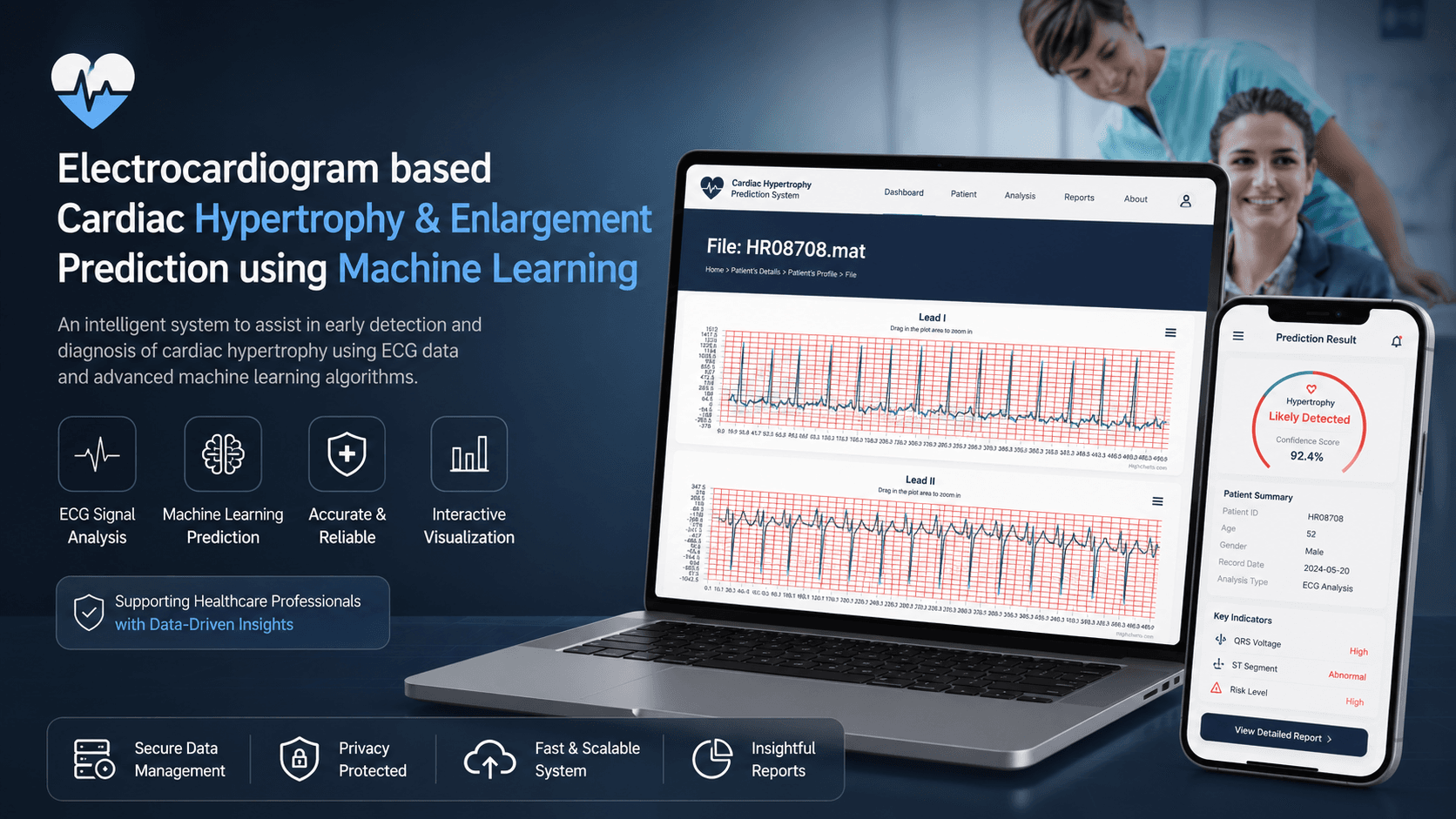
Final-year research project combining machine learning and a web application to predict cardiac hypertrophy and enlargement from electrocardiogram (ECG) records.
Problem
Cardiac hypertrophy and enlargement are serious conditions that require timely diagnosis from ECG readings. Manual interpretation is time-consuming and depends heavily on specialist availability. An automated screening tool could assist clinicians by flagging abnormal patterns earlier in the diagnostic workflow.
Approach
The project was delivered in two phases. First, machine learning models — including Random Forest and Convolutional Neural Networks — were trained on ECG datasets using SciPy and Biosppy for signal processing. Second, an Angular web application with a Flask API backend was built to upload ECG records, run predictions, and present results to users in a clear clinical interface.
Context
This research and development project was my undergraduate final-year dissertation. The goal was to design, develop, and evaluate a system capable of predicting cardiac hypertrophy and heart enlargement from ECG signal data — bridging clinical diagnostics with accessible software tooling.
Capabilities
What we built into the product
ECG Signal Processing
Preprocessing and feature extraction from raw ECG records
ML Classification
Random Forest and CNN models for hypertrophy detection
Clinical Web UI
Angular frontend for uploading records and viewing predictions
Research API
Flask backend serving model inference endpoints
Stack
Notes